Grilled Salmon
Two numbers get quoted for cooked salmon, and they answer different questions. The rest is grate management.
Total: 27 minYield: 4 servingsMethod: Grilling
In this recipe
145°F, and why you will see 125°F elsewhere
USDA FSIS publishes a single safe minimum internal temperature for fish: 145°F (63°C), measured at the thickest part. That is the figure this recipe cooks to and the figure in the instruction above.
Plenty of restaurant kitchens and home cooks pull salmon at 125°F to 130°F, and the migrated version of this page did the same. At that temperature the center is translucent and noticeably softer. It is a texture preference, and it sits below the published safe minimum — those are two separate statements and both are true.
Tasty Recipes states the safe figure in the method because that is the one with an authority behind it. The lower number appears in the recipe notes rather than being quietly deleted, so a reader who has seen it elsewhere knows exactly what the difference is and can make their own decision knowing which is which.
Practically, the gap is small on the grill — roughly ninety seconds on a fillet of this thickness. Overshooting well past 145°F is what actually ruins salmon, and that is a case for a thermometer rather than a clock.
Setting up the grill
Fish is the least forgiving thing on a grate, and almost all of that is decided before it goes on.
- Grates scraped clean while hot — old residue is what fish welds itself to.
- Grates oiled with a folded towel held in tongs, immediately before the fish goes on.
- Grill at a genuine medium, 325°F to 350°F. High heat scorches the surface before the center moves.
- Fish dry on both sides. Wet skin steams and sticks instead of crisping.
- Marinade on the flesh only. Anything sugary or garlicky on the skin will burn onto the bars.
- Thermometer and a wide, thin spatula within reach of the grill.
Reading the fillet
- It releases when it is readySkin-side down, the fillet is stuck until the skin has crisped, and then it lifts cleanly. Forcing it earlier tears the skin off and leaves it on the grate.
- The color line climbingWatch the side of the fillet. Opaque pink creeps up from the bottom as it cooks; when it is about three-quarters of the way up, it is close to the flip.
- Flakes, not falls apartA fork should separate the flesh into flakes with slight resistance. Flesh that collapses into paste has gone well past 145°F.
- One flip onlySalmon is fragile and every turn is a chance to break it. Six to eight minutes on the skin, two to four on the flesh, and nothing else.
Troubleshooting
| Problem | Cause | Fix |
|---|---|---|
| The fillet stuck and tore | Dirty or unoiled grates, wet fish, or it was moved too early. | Clean and oil the grates, dry the fish thoroughly, and wait for it to release on its own. |
| White curd on the surface | Cooked too hot or too far — that is albumin squeezed out of the muscle. | Drop to a genuine medium and take it off at 145°F. A little is normal; a lot means overcooking. |
| The skin is soft and rubbery | The grill was not hot enough, or the fish spent most of its time flesh-side down. | The majority of the cooking happens on the skin. That is what crisps it. |
| The outside is charred and the center is cold | The grill was too hot for a thick fillet. | Medium heat with the lid closed cooks it through evenly. The lid matters — it turns the grill into an oven. |
| The herbs burned black | Marinade went onto the skin side. | Brush the flesh only, and keep the skin to plain oil. |
Storage and reheating
Refrigerate cooked salmon up to 3 days in a sealed container. It is worth noting that cold leftover salmon is genuinely good — flaked into a salad or onto toast, it needs no reheating at all.
If you do reheat it, take it to 165°F (74°C), the USDA safe temperature for leftovers, in a covered dish at 275°F. That is a second cooking, and it will be firmer than it was off the grill; there is no way around that.
Cooked salmon freezes for up to 2 months but loses moisture noticeably. Freezing raw fillets and grilling them fresh gives a far better result.
Grilled Salmon
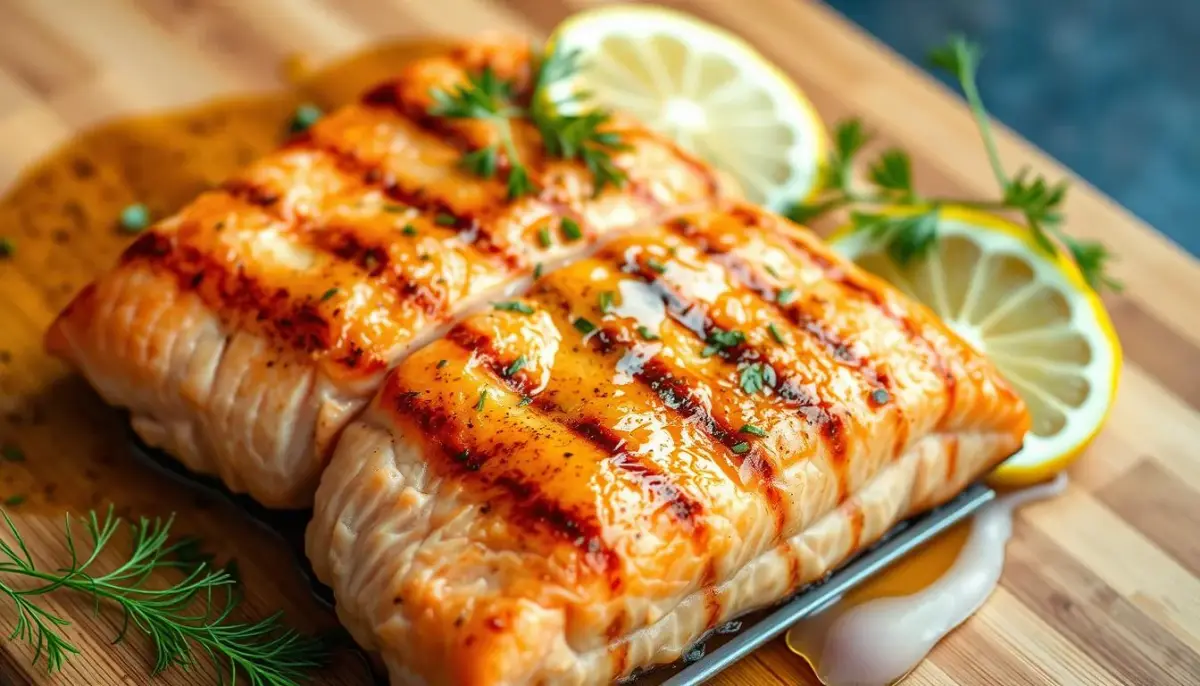
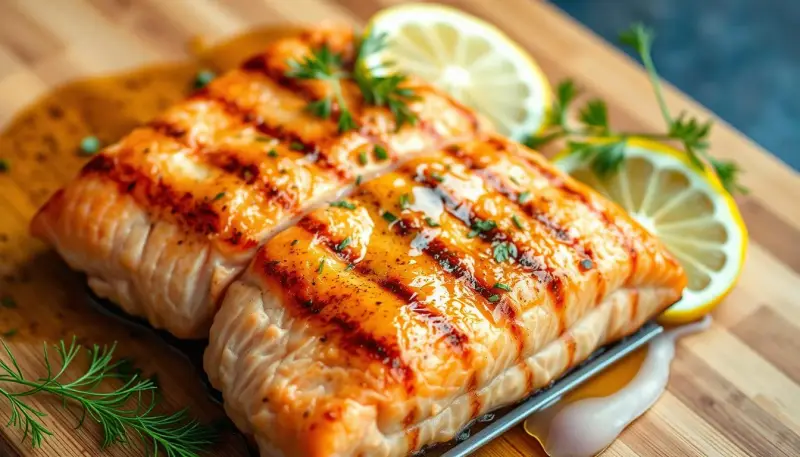
Skin-on fillets over a medium grill, marinade brushed on the flesh side only, cooked mostly on the skin until it crisps and releases on its own.
- Seafood
- Main Dish
- Grilling
Cook’s checkpoint
- Frying oil
- 350°F / 175°C
- Chicken, thickest part
- 165°F / 74°C
Use a food thermometer. Color and time alone don’t confirm poultry is done.
Ingredients
For the salmon
For the marinade
To serve
Instructions
Notes
- Many cooks pull salmon nearer 125°F to 130°F for a softer center, and the earlier version of this page used that figure. Tasty Recipes states 145°F (63°C) because that is the published USDA FSIS safe minimum for fish; the lower number is a texture preference, not a safety one, and is stated here so the difference is visible rather than hidden.
- Farmed Atlantic salmon carries more fat and is more forgiving over fire. Leaner wild fillets cook faster — check them a minute or two earlier.
Cooking Mode
Questions
- Skin on or skin off?
- Skin on, for this method. It holds the fillet together over the fire, protects the flesh from the direct heat, and crisps into the best part of the dish. Skinless fillets need a grill basket or foil to survive.
- How long does salmon take on the grill?
- Eight to twelve minutes in total for a fillet an inch or so thick, at 325°F to 350°F with the lid down. Thickness matters far more than weight, so measure the thick end and use a thermometer.
- Can this be cooked in a pan instead?
- Yes. A hot cast-iron skillet, skin-side down in a film of oil, for about the same times. The skin crisps at least as well and there is no sticking risk.
- Wild or farmed?
- Both grill well. Farmed Atlantic is fattier and more forgiving; wild varieties are leaner with a firmer texture and cook a little faster. Choose on availability and price rather than on the assumption that one is always better.