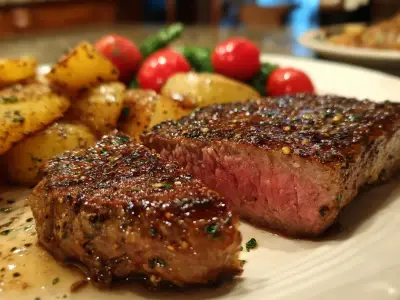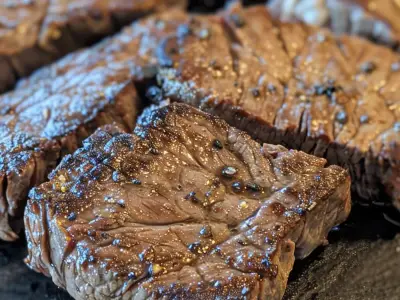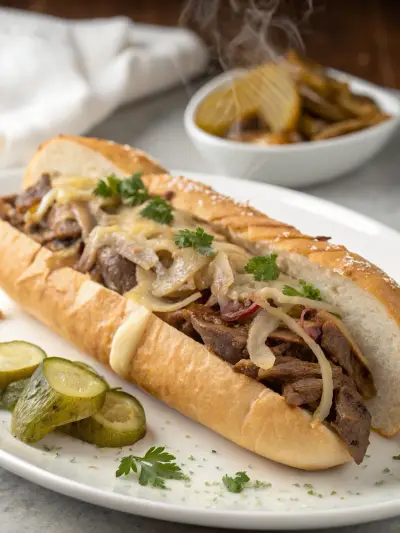
Beef Flank Steak
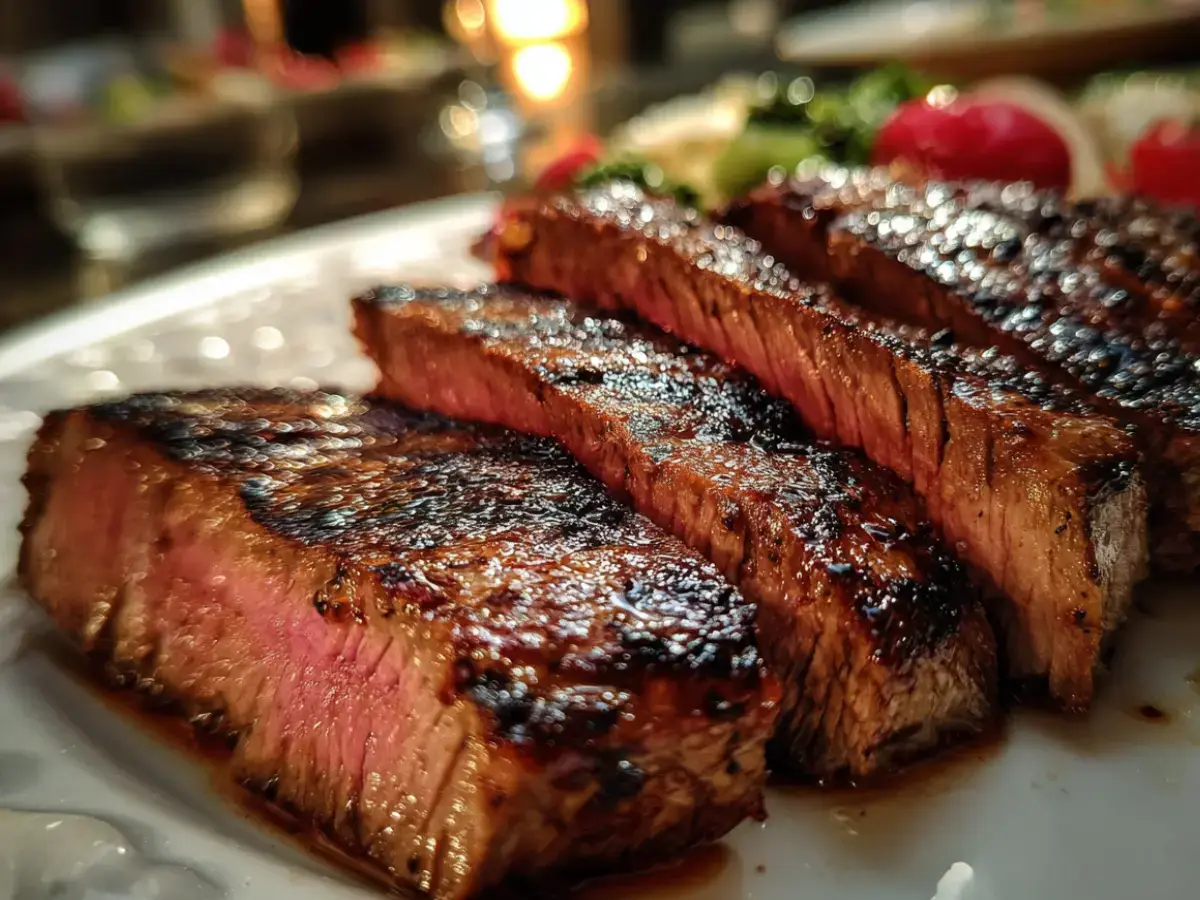
One cut where the knife matters as much as the fire — slicing with the grain will ruin a steak you cooked perfectly.
Total: 4 hr 30 minYield: 4 servingsMethod: Grilling
In this recipe
The grain, and why it decides everything
Flank comes from the abdominal muscle. It is lean, it has almost no internal fat, and its muscle fibers are unusually long, thick and all running the same way — visible as stripes down the length of the raw steak.
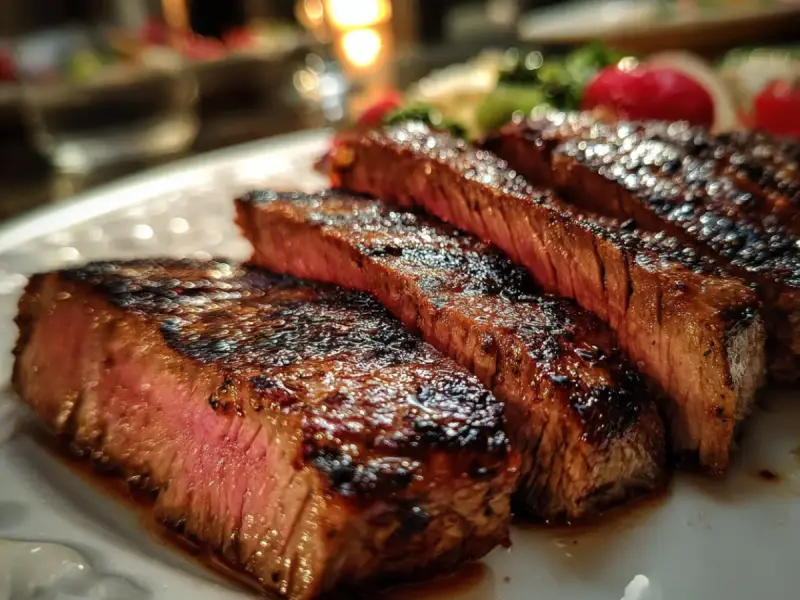
Those fibers are the reason a perfectly cooked flank steak can still eat like rope. Cut along them and every bite is a full-length bundle you have to chew through. Cut across them and the knife has already done that work, leaving short fibers that give way easily.
It is worth locating the grain before the steak goes anywhere near heat, because a browned, rested steak on a board is harder to read. Some cooks nick a corner as a marker. Slice across the stripes, thinly, at a slight angle, and a cheap cut eats like an expensive one.
What the marinade is doing
Four hours is a specific number, not a rough guide.
- Soy sauce
- Salt in liquid form, which penetrates far deeper than dry salt in the same time. It is also the main seasoning — the recipe adds only a teaspoon of salt on top.
- Lime juice
- Acid that loosens the surface proteins. It is also the ingredient with a deadline: past about eight hours it turns the outer layer chalky and soft.
- Brown sugar
- Two tablespoons, for browning rather than sweetness. Sugar caramelizes at grill temperature and is much of why the crust goes dark in six minutes.
- Olive oil
- Carries the fat-soluble flavor from the garlic and pepper flakes into the meat, and keeps a very lean cut from sticking.
- Dijon mustard
- An emulsifier as much as a flavor. It holds the oil and the citrus together so the marinade coats evenly instead of separating in the bag.
High heat, short clock
A lean inch-thick steak has very little margin, so each stage is short and deliberate.
- 450-500°FHigh enough to build a crust before the center overshoots. Moderate heat on a lean cut cooks it through gray before any color develops.
- Undisturbed, 4-6 minutesThe crust needs contact time. Moving the steak around resets the browning every time.
- One flipFlank is thin enough that repeated turning just cools it. One flip, one more 4 to 6 minutes.
- 145°F, then 3 minutesThe USDA figure includes the rest. The temperature continues to even out through the meat during it.
- Ten minutes on the boardLonger than the safety rest, for a practical reason: juice that runs out onto the board is juice that is not in the steak.
Troubleshooting
| Problem | Cause | Fix |
|---|---|---|
| It is tough despite being cooked correctly | Sliced with the grain. | Look for the long stripes and cut across them. This single change is the difference. |
| No crust formed | The steak went on wet, or the heat was too low. | Scrape the marinade off, pat dry, and get the grill genuinely hot before it goes on. |
| The surface is mushy | Marinated too long. | Four hours, eight at the outside. Citrus and soy keep working the whole time. |
| The outside burned before the center was ready | The brown sugar caught over very high heat. | Stay nearer 450°F than 500°F, and move the steak to a cooler zone if it darkens early. |
| The board is flooded with juice | It was sliced too soon. | Ten minutes tented. There is no way to put that liquid back. |
Storage and reheating
Refrigerate sliced steak up to 3 days. Flank is one of the better cuts to eat cold — thin slices on a salad or in a sandwich need no reheating and none of the texture problems that come with it.
If you do reheat it, take it to 165°F (74°C), the USDA safe temperature for leftovers, briefly in a covered pan with a spoonful of broth. A lean cut reheated hard goes from tender to dry in under a minute.
Raw steak can sit in the marinade for up to 8 hours refrigerated but no longer. Cooked slices freeze for 2 months, though they lose noticeably more moisture than a fattier cut would.
Beef Flank Steak
A lean, strongly grained cut marinated in soy, citrus and garlic, cooked fast over high heat, and sliced thin against the grain. The slicing is not a serving suggestion — it is what makes the cut tender.
- Beef
- Main Dish
- Grilling
Cook’s checkpoint
- Frying oil
- 350°F / 175°C
- Chicken, thickest part
- 165°F / 74°C
Use a food thermometer. Color and time alone don’t confirm poultry is done.
Ingredients
For the marinade
For the steak
To serve
Instructions
Notes
- Steakhouse practice is to pull flank around 130°F to 135°F for a rarer center, and the migrated source for this page carried those figures. They sit below the published USDA minimum; the temperature in step 5 is the safe one, stated so the difference is visible rather than hidden.
- Flank and skirt steak are close cousins and this method suits both. Skirt is thinner and cooks about two minutes a side faster.
Cooking Mode
Questions
- How long should flank steak marinate?
- Four hours is the target and eight is the ceiling. Under two hours the marinade has barely penetrated; past eight the acid has gone from tenderizing the surface to degrading it.
- Can this be cooked indoors?
- Yes. A cast-iron skillet on high does it well and produces an even better crust than most home grills. Ventilate — the sugar in the marinade smokes.
- What is the difference between flank and skirt?
- Skirt is thinner, fattier and even more strongly grained; flank is broader and leaner. Both need the same treatment: fast heat and slicing against the grain. Skirt cooks about two minutes a side faster.
- Why cut on an angle?
- Slicing across the grain at roughly 45 degrees gives wider slices with the same short fibers. It is presentation more than texture, but it also makes it easier to keep the cut genuinely perpendicular to the grain.