
Cranberry Brie Stuffed Chicken
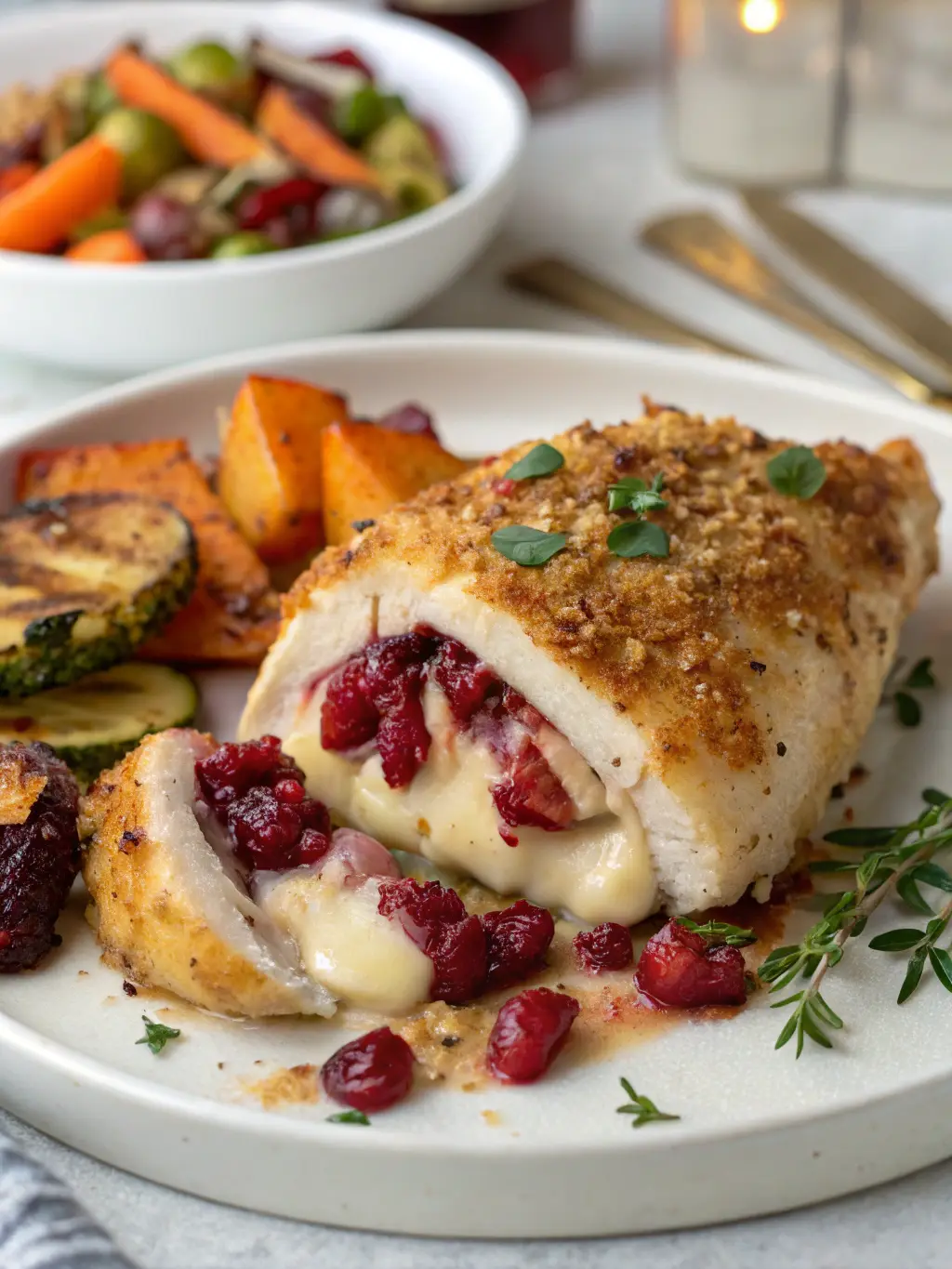
The whole dish depends on a cavity with three closed sides. Cut it wrong and you are baking chicken next to a puddle.
Total: 50 minYield: 4 servingsMethod: Baking
In this recipe
Cutting a pocket rather than a slit
A stuffed chicken breast fails in one of two ways, and both start at the knife. Cut too far and the pocket becomes a tunnel open at both ends; cut too shallow and there is nowhere for the filling to go.
The shape to aim for is a cavity with three closed sides — think of the breast as a pita rather than a sandwich. Enter through the thick side, keep the blade parallel to the board, and work it back and forth to widen the interior while keeping the entry narrow. Stop about half an inch short of the far edge, and the same from the top and bottom surfaces.
Holding the breast flat with your palm while you cut is what keeps the blade level. It feels precarious and is not — the knife travels away from your hand, not toward it.
Underfilling is the other half of the discipline. Chicken contracts as it cooks and squeezes the cavity, so a pocket packed to the brim will force its contents out no matter how well it is sealed. Two slices of brie and a heaped tablespoon is genuinely enough for an eight-ounce breast.
Sealing it properly
Five things, each of which prevents a specific leak.
- Rind left on the brie — it acts as a skin and holds the melted cheese together.
- Whole-berry cranberry sauce, not jellied, so the filling keeps some structure.
- Filling kept back from the opening by about half an inch.
- Two toothpicks per breast, pushed through at an angle rather than straight — angled picks pull the opening closed instead of just pinning it.
- Seared seam side up first, so the opening sets before it ever faces the pan.
Sear, then oven
One skillet, moving from the burner to the oven, because a stuffed breast is too thick to cook through in a pan.
- Sear, 3 minutes a sideColor only. A stuffed breast is well over an inch thick and would burn outside long before the center was safe.
- Butter, then the ovenAdded at the transfer so it does not brown during the sear. It bastes the top as the skillet goes in.
- 375°F for 15-18 minutesEven, surrounding heat. Moderate rather than hot, because the filling needs time to melt without the meat overshooting.
- Probe the meat, not the fillingMelted brie reads hotter than the chicken around it and will tell you the breast is done when it is not. Aim the probe into the thickest muscle, clear of the cavity.
- Rest 5 minutes, picks lastThe filling is molten at this point. Five minutes lets it set enough to stay put when the toothpicks come out.
Troubleshooting
| Problem | Cause | Fix |
|---|---|---|
| The filling leaked out | The pocket was cut through, or it was overfilled. | Three closed sides, and filling kept back from the opening. Two slices of brie is the right amount. |
| The chicken is dry but the filling is cold | The oven was too hot, so the outside outran the middle. | 375°F rather than higher. A thick stuffed breast needs moderate heat and time. |
| The thermometer says 165°F but the meat is pink | The probe hit the filling. | Melted cheese runs hotter than the meat. Probe the thickest muscle, away from the cavity. |
| The filling is a syrup with no texture | Jellied cranberry sauce. | Whole-berry. The pecans also help hold it together. |
| The pocket tore during searing | Seared seam side down first. | Seam up for the first three minutes so the opening sets before it takes any weight. |
Storage and reheating
Refrigerate up to 3 days, whole rather than sliced — a cut stuffed breast dries at the exposed face and the filling weeps.
Reheat to 165°F (74°C), the USDA safe temperature for leftovers, covered at 325°F for about 15 minutes. The brie will not return to its original texture; it firms after chilling and reheats grainier, which is unavoidable.
They can be stuffed and refrigerated up to a day ahead unbaked, which actually makes the pockets easier to handle when cold. Do not freeze — brie separates on thawing and the cranberry releases water into the meat.
Cranberry Brie Stuffed Chicken
Chicken breasts cut into a pocket, filled with brie and cranberry sauce, seared and finished in the oven. The pocket has to be cut so it holds — a slit that reaches the far side leaks everything.
- Chicken
- Main Dish
- Baking
Cook’s checkpoint
- Frying oil
- 350°F / 175°C
- Chicken, thickest part
- 165°F / 74°C
Use a food thermometer. Color and time alone don’t confirm poultry is done.
Ingredients
For the chicken
For the filling
To finish
Instructions
Notes
- Leave the rind on the brie. It holds the cheese together as it melts and keeps the filling from running out entirely; a rindless soft cheese leaks far more.
- Whole-berry cranberry sauce rather than jellied. The jellied kind liquefies completely in the oven and the filling becomes a syrup with no texture.
Cooking Mode
Questions
- What cheese works besides brie?
- Camembert behaves almost identically. Goat cheese holds together better and is sharper against the cranberry. Avoid anything hard — it will not melt into the filling.
- Can the breasts be stuffed in advance?
- Yes, up to a day, covered in the refrigerator. Cold breasts are firmer and easier to handle, and the searing time does not change.
- Do I need toothpicks?
- Something has to hold the opening. Kitchen twine tied around each breast works too, and is easier to remove. Count whatever you use so none reaches the plate.
- What should it be served with?
- Something that takes the sweetness without competing — roasted potatoes, a green vegetable, or a grain. Anything else sweet on the plate makes the whole thing cloying.