One-Pot Pomegranate Chicken and Rice
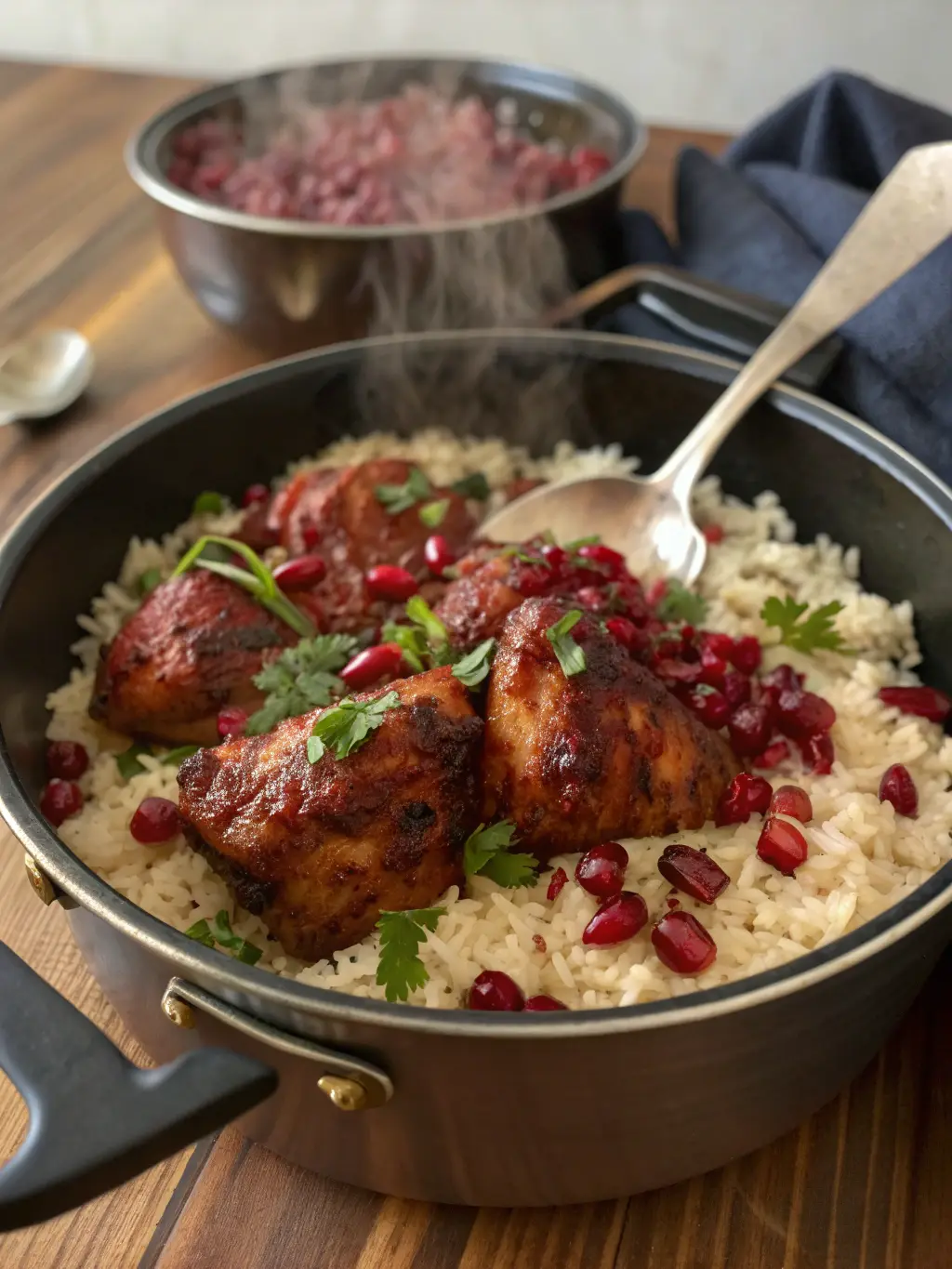
One pot, one liquid measurement, and a glaze that has to wait its turn.
Total: 1 hr 5 minYield: 4 servingsMethod: Braising
In this recipe
The liquid measurement is the whole recipe
In a one-pot dish the rice cannot be drained, so the ratio has to be right the first time. For rinsed basmati it is 1.5 parts liquid to 1 part rice — here, 2.25 cups of broth to 1.5 cups of rice.
Two things push that ratio around. Unrinsed rice carries surface starch that absorbs unevenly and turns the bottom gluey, which is why rinsing until the water runs clear is a step rather than a suggestion. And the chicken sitting on top releases juices as it cooks, which is already accounted for in the figure above — adding extra broth to be safe produces wet rice.
The lid matters as much as the measurement. Twenty-two to twenty-five minutes on low with the lid down, then ten minutes off the heat still covered. That final rest is where the grains finish absorbing and separate, and lifting the lid to check releases the steam doing that work.
Keeping the thighs clear of the liquid is the last piece. Skin submerged in broth goes soft; skin sitting above it stays crisp while the meat below cooks in the steam.
Why the glaze waits
Pomegranate molasses and honey are both sugar-heavy, and sugar has a low burning point.
- Sear dry, 6-7 minutesSpices only. The skin needs high heat and a dry surface, and anything sweet on it would blacken within two minutes.
- Glaze off the heatBrushed onto the seared thighs while they rest on a plate. It clings to the hot skin without ever meeting direct flame.
- Rice base in the same potThe fond from the searing lifts into the onion. This is where the pot's flavor comes from and why it is not washed between stages.
- Chicken back on top, coveredThe glaze now cooks gently in steam rather than over dry heat, so it sets and darkens instead of burning.
- Ten minutes off the heatLid still on. The rice finishes and the glaze firms into a lacquer on the skin.
Troubleshooting
| Problem | Cause | Fix |
|---|---|---|
| The rice is gluey | It was not rinsed. | Rinse until the water runs clear. This removes the loose surface starch and is the difference between separate grains and paste. |
| The rice is wet at the bottom | Extra broth was added, or the lid was lifted. | Keep to 2.25 cups and leave the lid alone through the cook and the rest. |
| The skin is soggy | The thighs sat down in the liquid. | Nestle them on top of the rice with the skin clear of the broth. |
| The glaze burned | It went on before the sear. | Sear dry, glaze afterwards. Sugar will not survive direct high heat. |
| The rice is done but the chicken is not | Boneless thighs or an unusually thick cut. | Use bone-in thighs, which are matched to this timing. If the chicken lags, finish it under the broiler while the rice rests. |
Storage and reheating
Refrigerate up to 3 days. The skin will not stay crisp, so there is no advantage to keeping the chicken and rice separate here.
Reheat to 165°F (74°C), the USDA safe temperature for leftovers, covered at 325°F with a splash of broth over the rice. Add the pomegranate seeds and pistachios fresh — both go soft after a night in the refrigerator and they are most of the texture.
It freezes for 2 months as a complete dish. Cooked basmati holds up better than most rice, though it comes back softer. Freeze without the fresh garnishes.
One-Pot Pomegranate Chicken and Rice
Chicken thighs seared, glazed with pomegranate molasses, and finished on top of rice that cooks in the same pot. The glaze goes on after the searing, because it would burn during it.
- Chicken
- Main Dish
- Braising
Cook’s checkpoint
- Frying oil
- 350°F / 175°C
- Chicken, thickest part
- 165°F / 74°C
Use a food thermometer. Color and time alone don’t confirm poultry is done.
Ingredients
For the chicken
For the glaze
For the rice
To finish
Instructions
Notes
- Pomegranate molasses is reduced pomegranate juice — sharp, dark and faintly bitter, not sweet. If you cannot find it, reduce a cup of pomegranate juice with a tablespoon of lemon juice to about a quarter cup.
- Bone-in, skin-on thighs are the right cut. Boneless thighs cook in less than half the time and the rice will not be ready; breast dries out entirely over 25 minutes.
Cooking Mode
Questions
- What is pomegranate molasses?
- Pomegranate juice reduced to a thick syrup. It is sharp and tart rather than sweet, with a faint bitterness. It is not interchangeable with pomegranate juice, which is far thinner and much less concentrated.
- Can boneless chicken be used?
- Boneless thighs work but cook in roughly 15 minutes, so add them partway through rather than at the start. Breast is not suited to this timing at all.
- Can another rice be used?
- Long-grain white works at the same ratio. Brown rice needs considerably more liquid and about twice the time, which puts it out of step with the chicken.
- Are the pomegranate seeds necessary?
- They are the only fresh, sharp element on an otherwise soft plate, so they do real work. If they are unavailable, a squeeze of lemon at the table covers some of the same ground.