Hamburger Potato Casserole
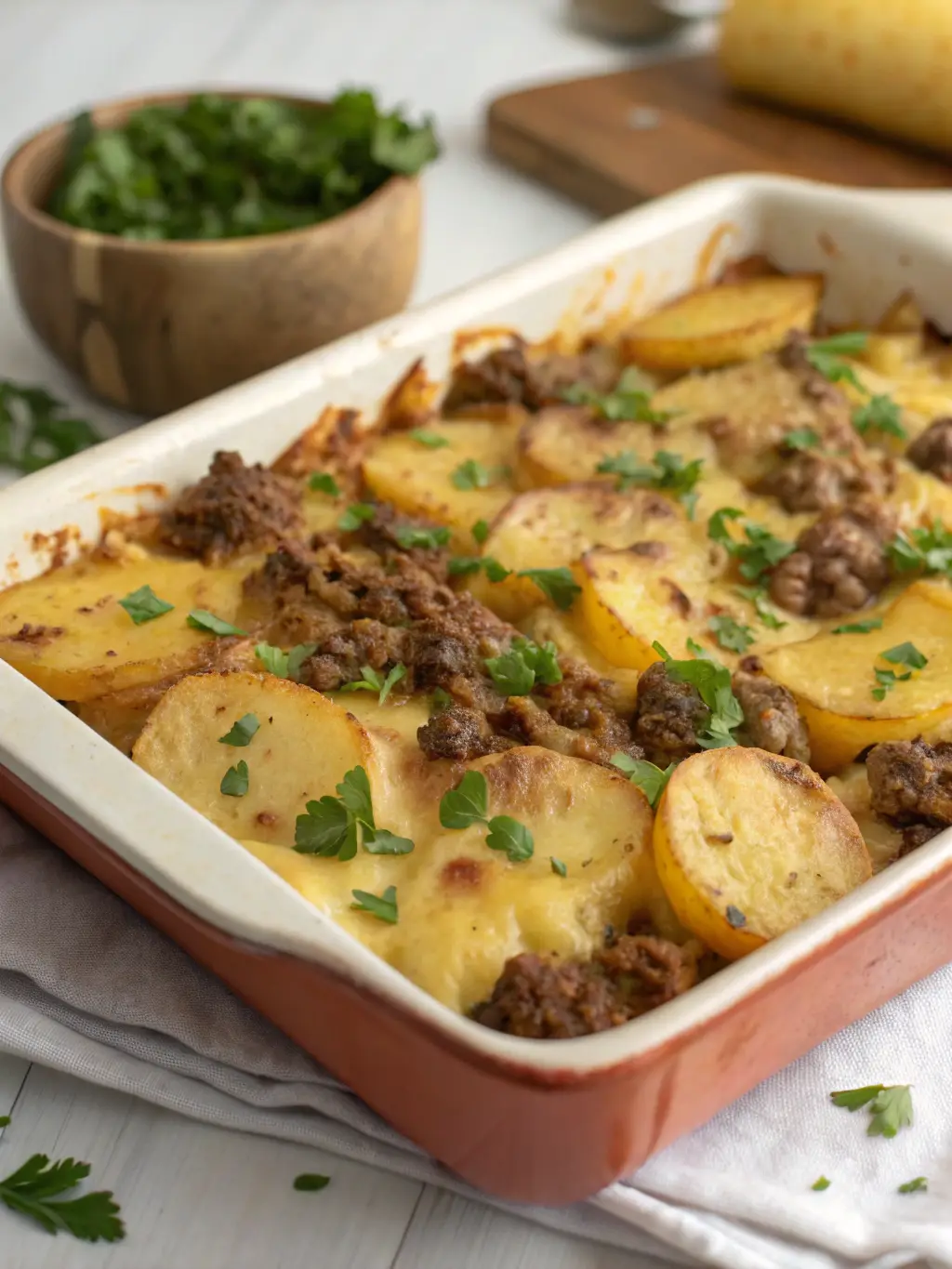
One measurement decides whether this works: an eighth of an inch.
Total: 1 hr 45 minYield: 6 servingsMethod: Baking
In this recipe
Why an eighth of an inch
Raw potato in a covered dish cooks by steam, and steam moves through a thin slice far faster than a thick one. At an eighth of an inch, a slice is tender in about fifty-five minutes. At a quarter inch it needs closer to ninety, by which time the top layer has dried and the cheese has gone past golden into brown.
This is the reason so many versions of this dish come out with hard potato in the middle. It is almost never the oven or the timing — it is that the slices were cut by eye and came out uneven, so some were done and others were not.
The practical test is translucency: hold a slice up and the edge should let light through. Consistency matters more than hitting the exact number, so if slices vary, sort the thickest to the bottom layer where they get the most heat.
How it stacks
Two potato layers, two beef layers, three sauce additions — and the last one is not a garnish.
- Potato, overlappedLike roof tiles rather than laid flat side by side. Overlapping gives an even depth and keeps the sauce from running straight to the bottom.
- Beef, then sauce, then cheeseIn that order. Sauce poured over cheese sits on top of it; sauce under the cheese soaks into the potato where it is needed.
- Repeat onceTwo rounds is right for a 9x13. Three thinner rounds also works but is fiddly and gains nothing.
- The final third of the sauce, pressed inPoured over the whole surface and pressed down with a spatula. This is what gets liquid into the lower layers, and skipping it is why the bottom sometimes stays dry.
- Cheese last, uncoveredThe final cup goes on only after the foil comes off. Under foil for an hour it would render into grease rather than brown.
Troubleshooting
| Problem | Cause | Fix |
|---|---|---|
| The potato is still hard | Sliced too thick, or baked uncovered. | An eighth of an inch, and foil on for the first 55 minutes. The steam is what cooks it. |
| It is watery | The potatoes were rinsed after slicing, or the sauce was too thin. | Do not rinse — the surface starch is helping the dish set. Reduce the sauce until it coats a spoon before it goes in. |
| The top burned before the middle was done | The foil came off too early. | Fifty-five minutes covered is not negotiable. The last 15 to 20 minutes uncovered is enough to brown. |
| It falls apart on the plate | Served straight from the oven. | Fifteen minutes of rest. The starch sets noticeably as it cools. |
| It tastes bland | Both the beef and the sauce were seasoned lightly. | There is a lot of potato here to season. Both layers need their own salt — one seasoned component cannot carry the dish. |
Assembling ahead
This can be built completely and refrigerated for up to a day before baking, with one caveat: sliced raw potato oxidizes and grays at the surface. Keeping the slices fully covered by sauce prevents it, so press the layers down and make sure nothing is exposed.
From cold it needs roughly 15 extra minutes under foil. Let the dish stand out while the oven heats rather than moving it straight from refrigerator to hot oven.
The beef and the cream sauce can also be made separately up to two days ahead, which turns assembly on the day into a ten-minute job.
Storage and reheating
Refrigerate covered up to 4 days. Cut portions keep better than a whole pan — the exposed faces cool quickly and the layers firm up.
Reheat to 165°F (74°C), the USDA safe temperature for leftovers, covered at 325°F for about 20 minutes. Uncovered reheating dries the top layer of potato before the middle is warm.
It does not freeze well. Cooked potato slices turn grainy and the milk-based sauce separates; neither recovers on thawing.
Hamburger Potato Casserole
Thinly sliced potato layered with seasoned ground beef under a from-scratch cream sauce and baked covered until the potato is tender. The sauce is made rather than opened, so the salt stays controllable.
- Beef
- Main Dish
- Baking
Cook’s checkpoint
- Frying oil
- 350°F / 175°C
- Chicken, thickest part
- 165°F / 74°C
Use a food thermometer. Color and time alone don’t confirm poultry is done.
Ingredients
For the beef layer
For the cream sauce
To assemble
Instructions
Notes
- A mandoline makes the 1/8-inch slicing consistent in about two minutes. By knife it is achievable, but even thickness matters more than hitting the exact number.
- Russets are right here. Their starch thickens the sauce slightly as they bake, which is why this sets rather than staying soupy.
Cooking Mode
Questions
- Can canned soup replace the cream sauce?
- It will work mechanically. The reason to spend five minutes on a roux is salt — a condensed soup brings a fixed and fairly high amount, and this dish already has seasoned beef and two cups of cheddar in it.
- Do the potatoes need par-boiling?
- Not at an eighth of an inch. Par-boiling is a workaround for slices cut too thick, and it makes them more likely to break up during layering.
- Can a different potato be used?
- Yukon Gold works and holds its shape more firmly. Russets are preferred here because their starch helps the dish set. Waxy red potatoes are the weakest choice — they stay distinct and the casserole never binds.
- How do I stop the potatoes graying if I assemble ahead?
- Keep every slice under sauce. Oxidation needs air contact, so pressing the layers down and covering the surface completely is enough — no acid or water soak required.