Meatloaf Mac and Cheese Casserole
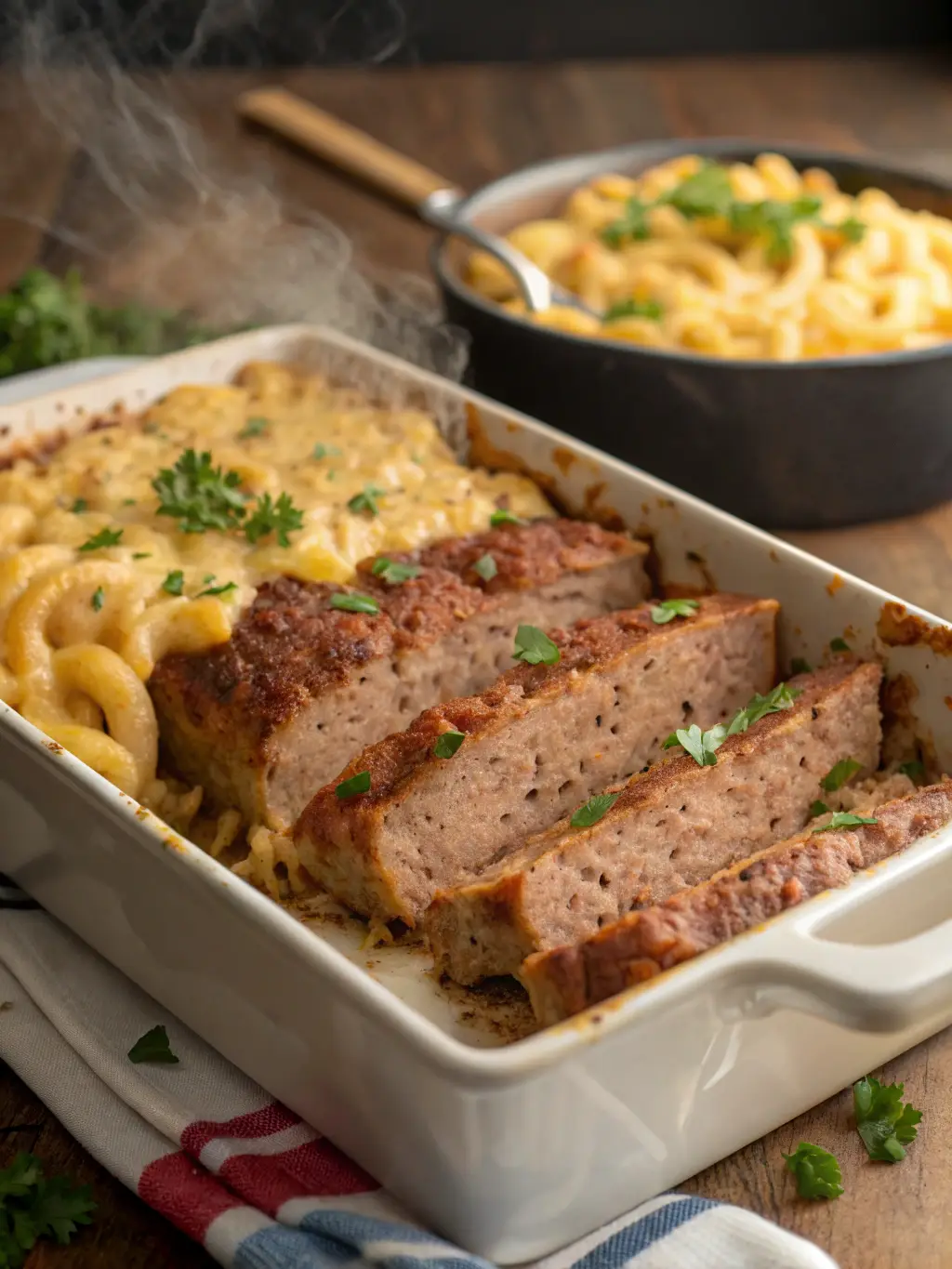
Two comfort dishes that normally sit side by side, cooked so the juices from one run into the other.
Total: 1 hr 40 minYield: 8 servingsMethod: Baking
In this recipe
Why the loaf is baked before it meets the pasta
The obvious approach is to sit a raw loaf on the macaroni and bake everything together. It produces a pale, steamed loaf and greasy pasta, because raw ground beef in contact with a wet surface never develops a crust and renders its fat straight down.
Thirty minutes alone on a sheet pan fixes both. The loaf firms up, browns on all sides, and gives up most of its fat where it can be left behind. What runs into the macaroni during the final twenty minutes is seasoned juice rather than grease.
The glaze follows the same logic in miniature. Ketchup and brown sugar burn over a full hour, so half goes on at the thirty-minute mark and the rest when the loaf moves onto the pasta — enough time to set and gloss, not enough to blacken.
What holds the loaf together
A meatloaf that crumbles and a meatloaf that is dense are usually failures of the same three ingredients.
- Panko soaked in milk
- A panade. It brings moisture in rather than absorbing it out, and its starch physically blocks the meat proteins from linking into a tight, springy network.
- Two eggs
- The structural binder. One egg in two pounds of beef is not enough and the slices fall apart; three makes it noticeably rubbery.
- Grated onion
- Grating releases juice and eliminates the raw crunch that diced onion leaves in a loaf this size. It also distributes evenly, which diced onion never quite does.
- 85% lean beef
- Leaner than this and the loaf is dry; fattier and it renders enough to leave a hollow. This is the standard ratio for meatloaf for a reason.
- Worcestershire
- Two tablespoons across two pounds. It is doing the savory work that a long-cooked sauce would otherwise do in a dish with no braising liquid.
The hour, in three parts
Three separate oven stages, because the two components want different things.
- Loaf aloneOn a sheet pan at 375°F. Browning and fat rendering, both of which need dry heat and open sides.
- First glazeHalf the glaze, ten minutes. Long enough to set into a lacquer, short enough not to catch.
- TogetherThe loaf moves onto the macaroni, the second glaze goes on, and the remaining cheddar goes around it. Twenty to twenty-five minutes to bring the loaf to 160°F and brown the pasta edges.
Troubleshooting
| Problem | Cause | Fix |
|---|---|---|
| The loaf crumbles when sliced | Not enough binder, or it was cut immediately. | Both eggs and the full milk-soaked panko, and a 15-minute rest before the knife. |
| The loaf is dense and springy | The mixture was overworked. | Combine with hands only until the dry streaks disappear, then stop. |
| The macaroni is mushy | It was boiled to full al dente before baking. | Two minutes short. It keeps cooking in the oven for twenty-five more. |
| The glaze burned | It all went on at the start. | Half at thirty minutes, half at the assembly. Sugar and ketchup will not survive a full hour. |
| The cheese sauce is grainy | The cheddar went in over direct heat, or it was pre-shredded. | Off the burner, and grate from a block. |
Storage and reheating
Refrigerate covered up to 4 days. Slice the loaf before storing — cut portions with macaroni underneath reheat far more evenly than a whole pan does.
Reheat to 165°F (74°C), the USDA safe temperature for leftovers, covered at 325°F for about 20 minutes with a splash of milk stirred into the pasta first. The macaroni absorbs the sauce overnight and always looks dry the next day.
The meatloaf freezes well on its own for 3 months, sliced or whole. The mac and cheese does not — a flour-and-cheddar sauce separates on thawing and the pasta turns soft.
Meatloaf Mac and Cheese Casserole
A seasoned meatloaf baked directly over macaroni in a cheddar sauce, so the meat juices run into the pasta. Two dishes in one pan, with a glaze that goes on only for the last stretch.
- Beef
- Main Dish
- Baking
Cook’s checkpoint
- Frying oil
- 350°F / 175°C
- Chicken, thickest part
- 165°F / 74°C
Use a food thermometer. Color and time alone don’t confirm poultry is done.
Ingredients
For the meatloaf
For the glaze
For the mac and cheese
Instructions
Notes
- The loaf is baked separately first for a reason: sitting on raw macaroni from the start it would steam rather than form a crust, and its fat would render straight into the pasta.
- Dry mustard powder in a cheese sauce is not detectable as mustard. It sharpens cheddar and is the difference between a sauce that tastes of cheese and one that tastes merely of dairy.
Cooking Mode
Questions
- Can the meatloaf be made a day ahead?
- The mixture can be shaped and refrigerated a day ahead, which helps it hold its form. Bake it fresh; a fully baked loaf reheated on top of pasta dries out.
- Can boxed mac and cheese be used?
- It will work. The reason for the five-minute roux is salt and thickness — a boxed sauce is thinner and considerably saltier, and this dish already carries a seasoned loaf and a glaze.
- What pasta shape besides elbows?
- Small shapes with texture: shells, cavatappi or ditalini. Anything large enough to hold a whole spoonful of sauce inside works against a dish that is already rich.
- Why grate the onion instead of dicing it?
- Diced onion in a two-pound loaf stays crunchy in places and creates weak points where slices break. Grated, it disappears into the mixture and adds moisture.